Translate

Friday, July 5, 2019

Harbour Grace Nl. June 3-7 and Bonavista Nl. June 7-11 2019.

We have always wanted to visit Newfoundland  so last winter Dian and I decided to start making plans.  We reserved 6 Airb&b's, a rental car and got a flight out of Abbotsford for the 2nd of June.  This blog (the first of 3) covers the first 2 accommodations.      
We arrived in St. John's in a pouring rain after an all night flight.  Luckily our first house in Harbour Grace was only an hour and a half away.  Harbour Grace was the location where Amelia Earhart landed after being the first woman to cross the Atlantic.

We had the whole house to ourselves.  This picture also shows our new rented Jeep with 300 kilometres on it.  By the time out trip was over we had logged over 8000 kilometres.  This location gave us a base to tour the whole peninsula including sites like Hearts Content where the first trans Atlantic cable terminated.  
Dian in the kitchen.  This house was on an ocean inlet and was very well equipped.  
Dock at the rear of the house.
Black Ducks are very common here and they were resident on our waterfront. 

Len and Amelia Earhart in Harbour Grace where she took off on her trans Atlantic flight in 1932.
This is a shot of Bay de Verde.  A typical picturesque fishing town further up the road from Harbour Grace.
Bay de Verde's Harbour

Black-throated green Warbler.  Not a bird we often see in our part of B.C.
Boreal Chickadees appeared to be more common here than Black-capped Chickadees.
This Dark-eyed Junco is of the Slate-colored variety.  This color morph was the only one we saw here.
The beginning of a trail we hiked, warned us of fairies.  We didn't see any but did find their house. Close to Red Head Cove.
Greater Black-backed Gulls cause a lot of excitement when one shows up in B.C. but they are very common here.
Greater Yellowlegs.
Another common gull is the Herring Gull.  Here a male and female were canuggling (I looked that up).
We got a tip there was an iceberg in the harbour of  Grates Cove.  This a small village on the tip of the  Avalon Peninsula.
And there it was-right in the harbour.  
We returned 2 days later to find a huge chunk had dropped out of the centre.
We subsequently found more bergs in this area.  Here are 2 of them.


A picture of a Northern Waterthrush. Another common bird here but not easy to find as they like to stay hidden.
White-throated Sparrows are common across Canada and we had no problem finding them here.
Yellow Warbler.  They are common across Canada and we have found these delicate looking birds above the Arctic Circle on a previous trip.  
Our second stop was Bonavista which was about 3 hours further north.
The B&B here was in a converted catholic hall.  Our room was in the right hand corner closest to the front and our hostess was Johanna.  She made a lovely  traditional breakfast for us every morning. 
Elliston is close to Bonavista and it has a colony of Puffins nesting on an island.


Puffins nest in holes in the ground.  The iceberg was nice touch.
Johanna's daughter told us about a family of foxes in Elliston.  We found them right away.  Here is the mother.  (I think).  She had 2 kits which she left alone while she hunted.


Elliston also is famous for root cellars.  "Through the coordinated efforts of Memorial University of Newfoundland, Tourism Elliston and Human Resources Development Canada, Elliston was able to officially declare itself the "Root Cellar Capital of the World" in July 2000. Elliston boasts 135 documented root cellars, some of which have survived nearly two centuries. This makes Elliston a cultural center for those who seek to gain an understanding of early Newfoundland subsistence."

A view from our room in Bonavista.

Another view from our room.  Isn't this exciting?
Bonavista harbour.  Taken while on a Zodiac tour.

Bonavista "catches" many icebergs because of its location.


This iceberg was covered in alluvial deposits from somewhere in Greenland where it originated.


These iceberg photos were all taken from our zodiac.    This was a great way to get up close and the weather was perfect.
This dock was home base for the zodiac.


End of this blog.  Scroll down for previous blog or hit "Older posts".


Tuesday, May 28, 2019

May 21-27 2019. Visit with the Strombergs, Sooty Grouse, Spruce Grouse, Porcupine


          We have just returned from a short trip to the interior.  Our trailer manufacturer (Escape Trailers of Chilliwack) was holding a rally in Osoyoos which is always fun to attend.  Our friends, the Strombergs, invited us to stop in at their property, just north of Princeton, on the way there and we gratefully accepted.  We spent a couple of nights with them before carrying on to the rally.

Here we are with Marion and Gord.  It has been many years since Gord and I sat around a campfire.  Great fun.
One evening Gord and Marion drove us back into the hills where Gord spotted this Porcupine.  


Dian spotted this moose trotting across the clearcut at about 300 meters.
On the way home we camped at Manning Park.  A trip up to a lookout produced a displaying Sooty Grouse.
The grouse had decided it had enough of me and tried to chase me away.  It never touched me but came too close for my camera to focus.
He knows how to look indignant.
Further down the road we found a Spruce Grouse.  I had to get low for this shot.
These birds are surprisingly easy to approach.
178 Escape trailers attended the rally on Osoyoos Lake.  Ours has the pink sign.

This weekend we are off to Newfoundland.  There should be a blog or two in the works on that trip.

Tuesday, January 22, 2019

Jan 2019, Cape May Warbler, Dusky Thrush-Nanaimo, Pied-billed Grebe, Anna's Hummingbird, Rough-legged Hawk, Wood Duck

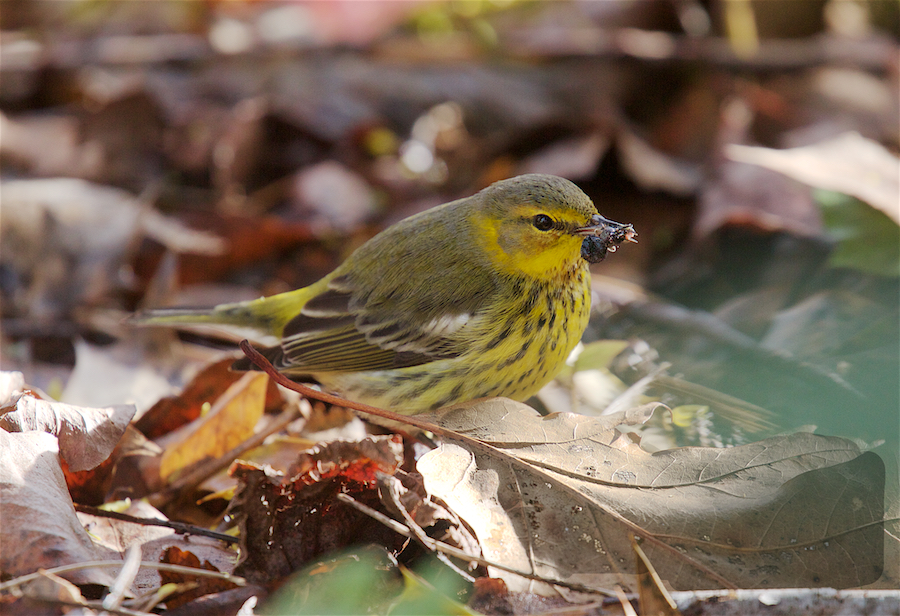
After the mega-rare Fieldfare last month in Salmon Arm we thought we had exhausted all the excitement for a while.  But on the first day of January a Cape May Warbler showed up locally here in Abbotsford, at Mill Lake.  This bird created a lot of interest amongst the many walkers and birders that frequent this area and it made the local news media. 
This Warbler can drink flower nectar and consume bugs to survive.

Although the Cape May has been known to nest in the Peace River area, this is the first record for it in southern BC.


I don't think I have ever seen a more obliging subject.  Its many admirers didn't seem to bother it at all.  As I write this, it has been in the same location for a least 22 days.  
Nectar has caked up on its bill but it was washed off the next day.

 The tongue of the Cape May Warbler is unique among warblers. It is curled and semitubular, and is used to collect nectar during winter.
This range map shows the Cape May should be in the West Indies this time of year.
This Pied-billed Grebe was frequenting the same area as the Cape May.
American Goldfinches were also at Mill Lake.

The Cape May Warbler considered Anna's Hummingbirds competition and it was kept busy chasing them away from the nectar source.

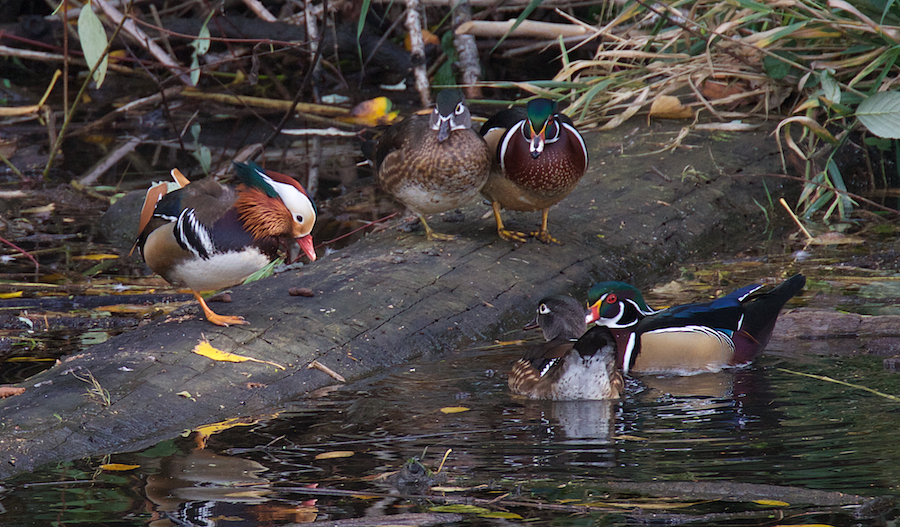
We had a Wood Duck pose for us.
A Rough-legged Hawk was vacationing in Delta, BC from its breeding grounds in the Arctic.

Just when we thought all the rare birds had been found, a report of a Dusky Thrush took us on a day trip to Nanaimo.  The bird was close to the ferry docks so we decided to go for it.  This is BC's third record for this Siberian beauty.  It was difficult to get a good picture but you get the idea.


End of this blog.  Scroll down for previous blog.

Tuesday, January 1, 2019

Nov 2018-Dec. 31 2018-Fieldfare, Mandarin Duck, Great Gray Owl, Leucistic Crow

This blog covers birds seen in November and December of 2018.  

In November there was a Mandarin Duck making headlines in Central Park, New York.  Then Vancouver news outlets (wanting to get in on the bandwagon) reported one in Burnaby.  Not to be outdone, Chilliwack also had one.  Many theories to their origin were speculated but anyone with a knowledge of birds realizes these ducks have probably escaped from some bird fanciers or farmer's yard.  The Wood Ducks above seem to find the Mandarin a source of curiosity. 
We spent a few days in Kamloops in December.  On a ride out in the grasslands we encountered an actively hunting Great Grey Owl.
This Mew Gull was hovering over the water gleaning Salmon eggs at the Kilby Eagle Festival.
We get many Common Mergansers spending the winter in our area.  If you look closely you will see the serrated edges on the upper bill.

Bald Eagles are always a welcome sight at an Eagle Festival.
Hooded Merganser.

A tip from the Fraser Valley Birding site led to us to Chilliwack to find this leucistic crow.  Leucism is a lack of pigment.  This crow appears to be silver.

This crow was quite skittish; probably because many people found it interesting.
It was acting like any other crow-turning over leaves looking for grubs.
One morning we had a Northern Shrike on our property.  These shy birds usually avoid humans but this one was quite approachable.
The big birding event of the month or possibly the year, was the report of a Fieldfare in Salmon Arm by Roger and Nan Beardmore, and Peter and Sharon Lawless. Amazing find.  The location is above.
After the hubbub of Christmas was over Dian and I went on a road trip to find this mega rarity.  We found it within 15 minutes of arriving and took some pictures under cloudy skies.
A variety of thrush, the Fieldfare is usually found in northern Asia and Europe.  
This one was keeping company with our common thrush, the Robin.  This is only the second time this species has been seen in British Columbia.
Mountain Ash berries were keeping it in one particular yard.  We went back to the location on our second day.  The sun was shining but the bird never got into a very good photographic position while we were there.  This was the best I could get.
One of the Fieldfare's companions (Robin) tosses back a Mountain Ash Berry.  As of Jan.1 2019 the Fieldfare had been at the same location for at least 2 weeks.


End of this blog.  Scroll down for previous blog.